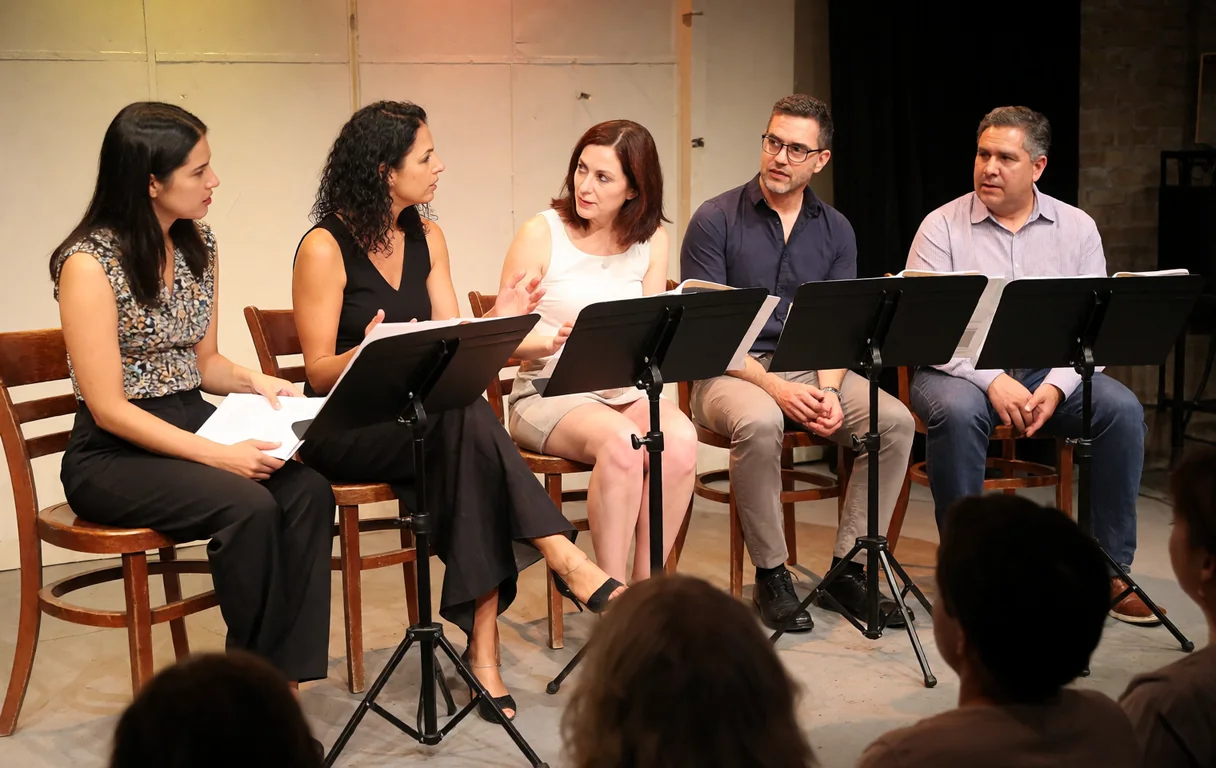
What is a staged reading?
A staged reading (also called a dramatized reading or a play reading) is a performance of a play in which the actors read from the script instead of performing it from memory. There is no full set and no full production. The actors bring the characters to life through their voices, emotions, looks and timing, and the audience’s imagination supplies the rest: the rooms, the actions, the places the story goes.
In Spanish we call it a lectura dramatizada, and the way I like to explain it is this: it is a theatre experience in which the actors give life to the characters through their voices, their emotions, their dialogue and their expressions, without needing every element of a full staging.
How a staged reading actually works
The actors do not memorize the script. As the name says, it is a reading. But that does not mean nobody prepared. We study the characters and we rehearse beforehand. We read the script with intention, we carry the feelings, and we recreate the situations.
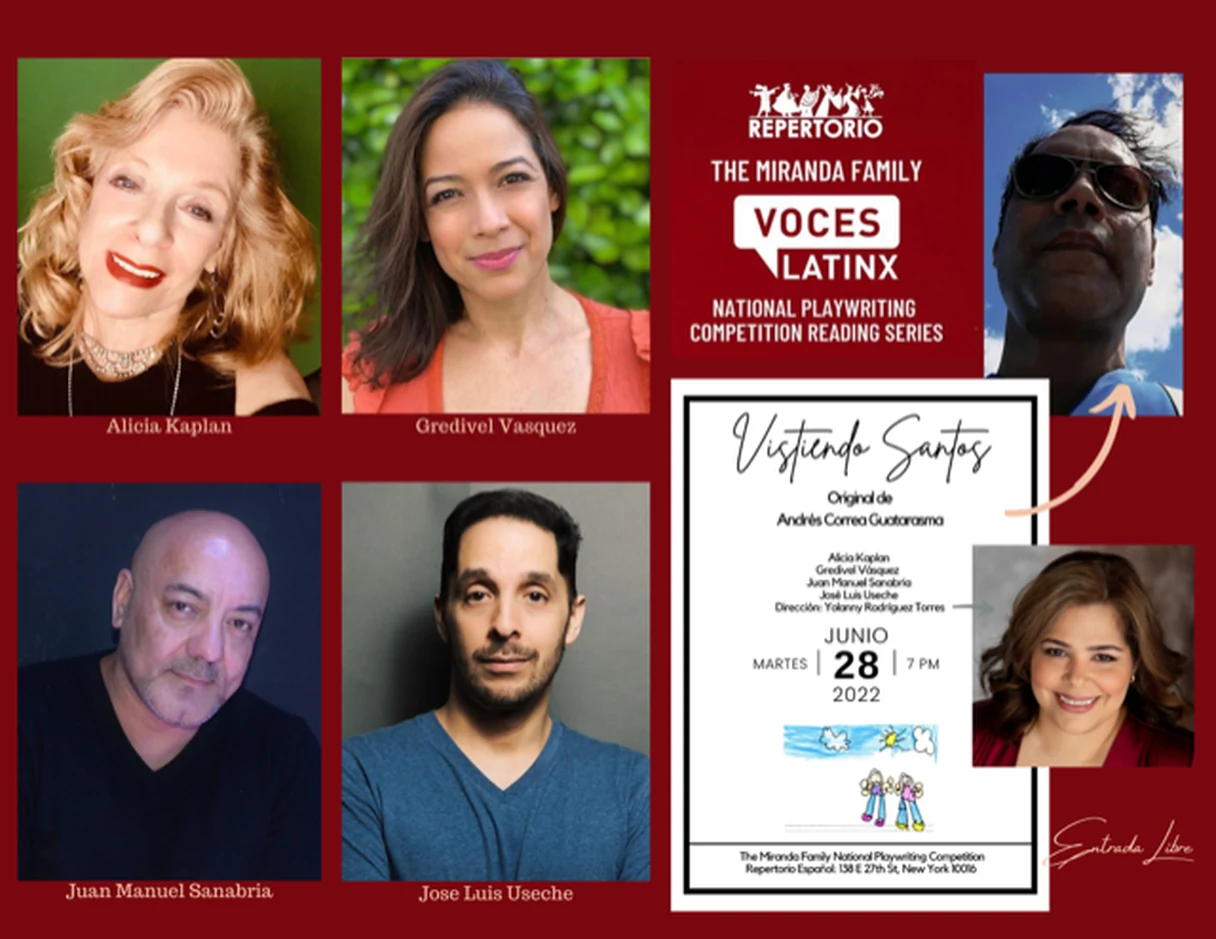
For Vistiendo Santos, the comedy I read at Repertorio Español in 2022 with Alicia Kaplan, we had about three rehearsals under the direction of Yolanny Rodríguez Torres. That is typical of a reading: a few rehearsals, not weeks.
A common belief is that a reading means no costumes at all. In our case that was not true. We wore suitable costumes and used a few key props, so the reading would flow and help the audience understand and enjoy it. Every reading decides how much of that it needs, but the script in hand is the one thing they all share.
Staged reading vs. full production vs. reader’s theater
| Staged reading | Full production | Reader’s theater | |
|---|---|---|---|
| Script | In the actors’ hands | Memorized | In hand, often on stands |
| Rehearsal | A few rehearsals | Weeks of rehearsal | Varies, often classroom-based |
| Set and costumes | Minimal: suggestive costume, a few key props | Full set, costumes, lights, sound | Usually none |
| Movement | Some, guided by a director | Fully blocked | Little or none; the voice does the work |
| Usual purpose | Introduce or develop a new play in front of an audience | A run of public performances | Reading practice and fluency, often in schools |
| Cost to attend | Often free | Ticketed | Usually free |
A table read is something else again: the cast reads the script aloud around a table, usually privately, before rehearsals begin. A staged reading is made for an audience.
Why theatres do staged readings
Readings are how many new plays meet their first audience. A playwright hears the words in actors’ mouths and learns what lands; a company tests a script before it commits to a full production; a contest presents its finalists. That is exactly what happened with Vistiendo Santos: it was one of five finalists in Repertorio Español’s 2022 Miranda Family Voces Latinx National Playwriting Competition, and every finalist got a free public reading in New York.
The play that took first place that year, Las vidas rotas, later had a full production, and I played Rosa in it. So I have seen from the inside how a play can go from a reading to the stage.
Why it is worth going to one
I am one of those people who thinks we should always take risks and step out of our comfort zone. A staged reading is a different, intimate and fascinating way to experience theatre.
It is not just listening to some actors read a text. It is watching the characters come alive through their voices, their emotions, their looks and their complicity.
There is something magical about it: the word becomes action, and your imagination completes what you do not need to see on a stage. It also lets you connect in a very special way with the story and with the actors.
It is worth it because theatre does not always need big sets to move you. Sometimes a good story, great performers and the willingness to let yourself be carried away are enough.
What to expect if you go
- Scripts on stage. The actors will be holding the text, or reading it from music stands. That is the form, not a sign that anything is unfinished.
- A shorter evening. Without scene changes, a reading usually moves quickly.
- Often free. Many readings, especially of new plays and contest finalists, cost nothing to attend. Our 2022 reading at Repertorio Español was free admission.
- New work. You may be among the very first people to hear a play that later becomes a full production.
In New York, Spanish-language readings happen at companies like Repertorio Español, where I have been a resident actress since 2000. If you have never been to one, go. Take the risk.
Top image: an illustration of a stage set for a staged reading. Promotional flyer for the Vistiendo Santos reading, 2022.
Comments
Leave a Comment
Comments appear right away.