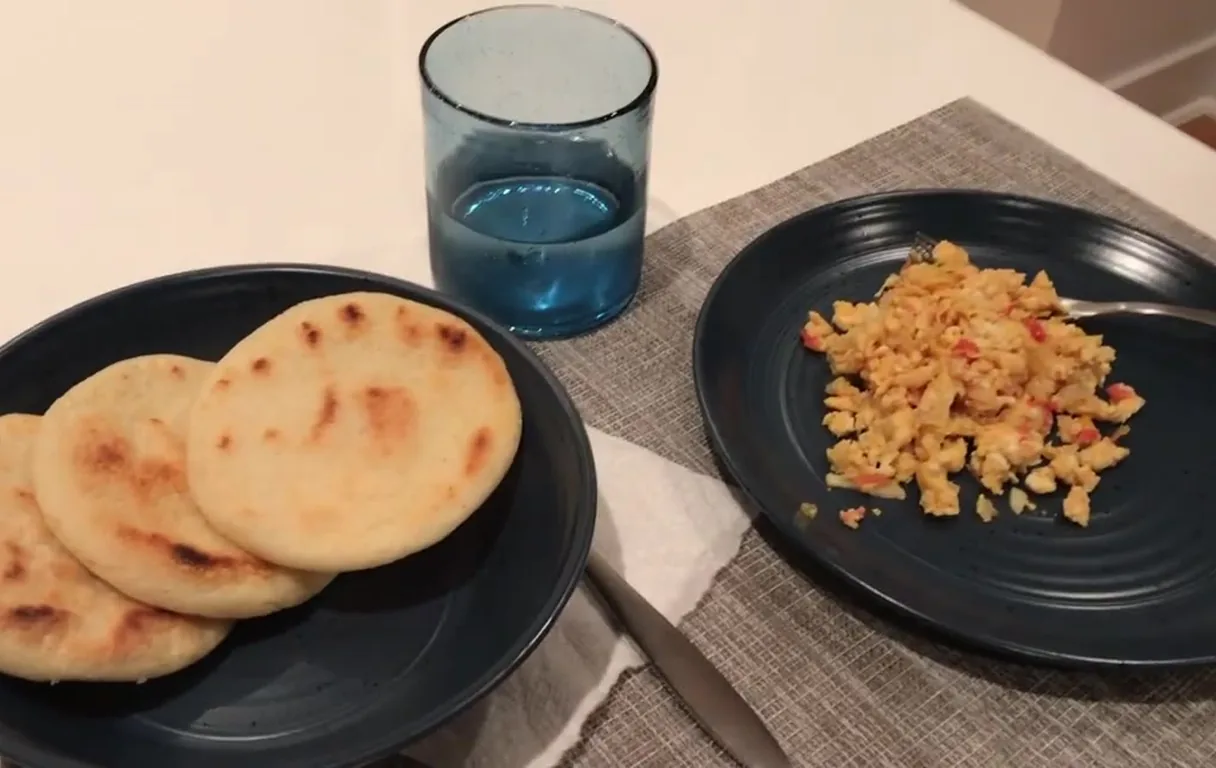
What you need
For the arepas, the ingredient list is so short it feels like a trick. It is not a trick — it is corn. Everything else is technique.
- 2 cups warm water (warm, not hot — comfortable to the touch)
- 1 teaspoon salt
- 2 cups precooked white cornmeal (in my house this has always meant Harina P.A.N.; any masarepa-style precooked cornmeal works, but it must be precooked — regular cornmeal or masa harina will not give you an arepa)
- A little oil for the pan
For the huevos pericos, for two people:
- 4 eggs
- 1 small onion, finely chopped (or 2 scallions, white and green)
- 1 ripe tomato, seeded and diced
- A little red bell pepper or ají dulce, diced, if you have it
- 1 tablespoon butter or oil, salt to taste
The arepas, step by step
- Salt the water. Pour the warm water into a wide bowl and dissolve the salt in it first. Salting the water instead of the flour means the seasoning is even all the way through.
- Add the cornmeal gradually. Pour it in a little at a time, stirring with your fingers so no dry pockets form. It will look like a loose porridge for a moment. Keep going.
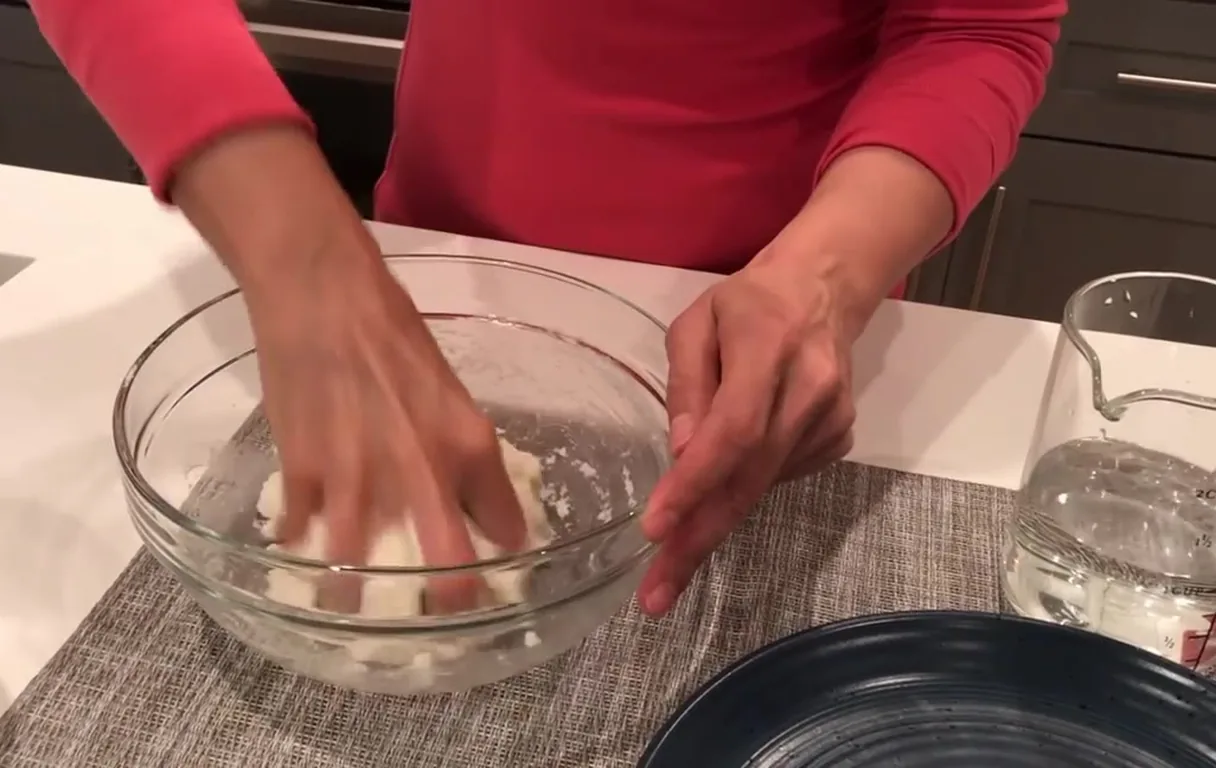
- Knead. Two or three minutes, pressing and folding with your hands, until you have a soft, smooth dough that does not stick to your fingers and does not crack when you press it. If it cracks at the edges, add a splash of water. If it is sticky, a spoonful more cornmeal.
- Let it rest. Five minutes, covered with a cloth. The cornmeal keeps absorbing water and the dough becomes silkier. This is the step people skip and then wonder why their arepas split.
- Shape. Divide the dough into balls a little bigger than a golf ball — six to eight. Roll each one smooth between your palms, then flatten it into a disc about four inches across and half an inch thick. Smooth any cracks around the edge with a wet fingertip. You will see me doing exactly this in the video: the whole rhythm of it is in the hands.
- Cook. Lightly oil a budare or a cast-iron skillet and heat it over medium. Lay the arepas in and leave them alone for five to seven minutes, until the underside is golden with darker spots. Flip and do the same on the other side. A finished arepa sounds hollow when you tap it. For a crispier crust, you can finish them in a 350°F oven for ten minutes.
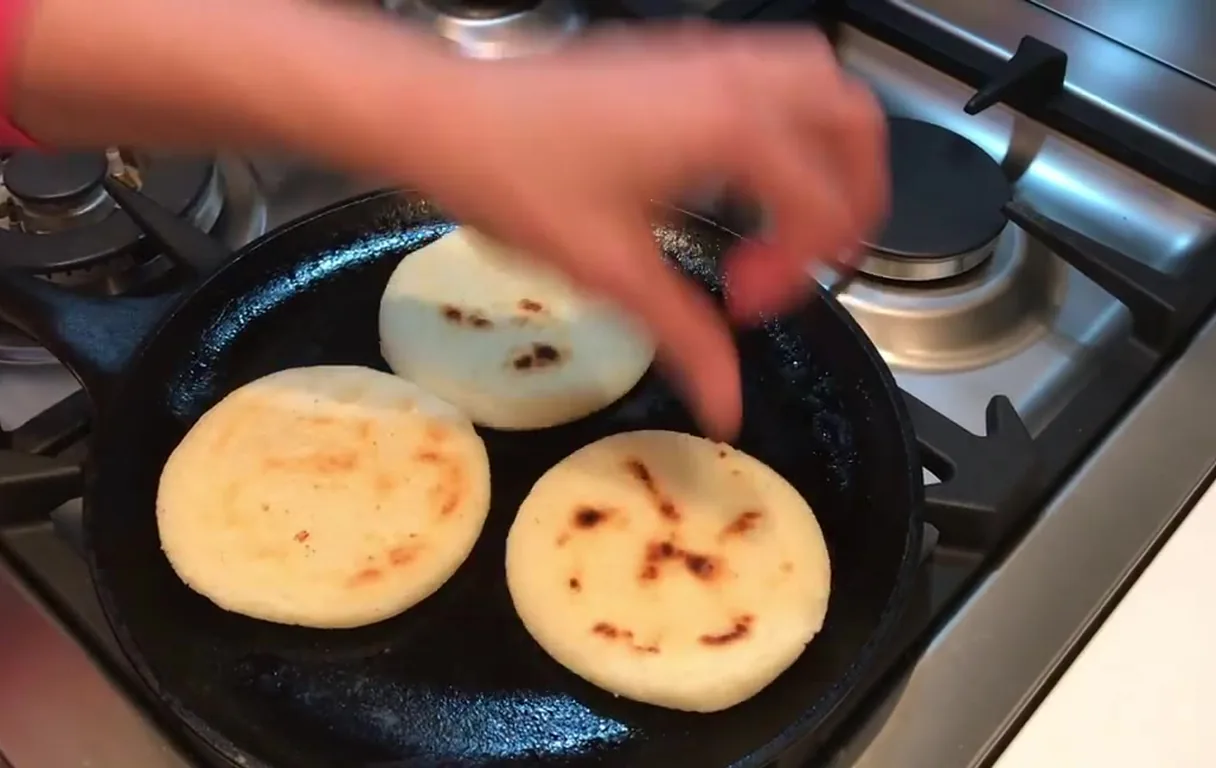
The huevos pericos
While the arepas cook, melt the butter in a pan over medium heat and soften the onion for two minutes. Add the tomato (and the pepper, if using) and cook until it collapses and the pan smells sweet, three minutes or so. Beat the eggs with a pinch of salt, pour them in, and lower the heat. Stir slowly and gently. You want soft, loose curds streaked with red and green — not dry scrambled eggs. Take them off a moment before they look done; they will finish in the residual heat.
The name, people will tell you, comes from the perico — the parakeet — because the yellow of the egg, the red of the tomato, and the green of the onion look like its feathers. I have never verified this with a bird. I choose to believe it.
To serve
Split each arepa along the edge like a pita, leaving a hinge, and fill it with the pericos. Or do what you see on my plate: arepas on one side, eggs on the other, and let everyone build their own bite. A slice of white cheese, a little butter melting into the hot corn, or a spoon of black beans on the side, and you have the breakfast that fuels a country. Coffee, of course. In my kitchen the moka pot is always on the stove.
Why the arepa matters so much to Venezuelans
An arepa is bread, but it is older than any bread the Spanish brought with them. The Indigenous peoples of what is now Venezuela and Colombia were grinding corn and cooking these discs on a clay plate called a budare long before 1492. The word itself is generally traced to erepa, the word for corn among the Cumanagoto people of eastern Venezuela. When a Venezuelan eats an arepa, she is eating something that has been made on this land, in more or less this shape, for thousands of years.
For most of that history it was hard work. Corn had to be soaked, husked, and pounded in a wooden pilón, then ground, every day, mostly by women. That changed in 1960 when Empresas Polar brought a precooked cornmeal to market under the name Harina P.A.N., based on a process patented a few years earlier by the Venezuelan engineer Luis Caballero Mejías. Suddenly an arepa took twenty minutes instead of a morning. The yellow bag with the woman in the headscarf became one of the most recognizable objects in the country, and the arepa went from being a farm food to being the food of everybody, everywhere, at every hour. Caracas has areperas open all night for a reason.
The arepa is also the most democratic food I know. The same disc of corn is breakfast for a construction worker and for a president. It is naturally gluten-free, it costs almost nothing, and it holds whatever you have: black beans and white cheese (a dominó), shredded beef, chicken with avocado (the famous reina pepiada, named for a 1950s beauty queen), or, on a plain Tuesday, just butter. The fillings have their own names and their own arguments. The corn underneath is the thing we agree on.
And now, for nearly eight million Venezuelans who live outside Venezuela — myself included — the arepa has become something more. It is the taste of a home many of us cannot easily visit. When I knead this dough in a New York kitchen, I am in my mother’s kitchen in Venezuela at the same time. That is not a metaphor. That is what food does. The Venezuelan diaspora even created a World Arepa Day, celebrated on the second Saturday of September, so that wherever we are scattered we sit down to the same plate on the same day. This year it falls on September 12. Make one.
My Colombian friends will remind me, rightly, that the arepa is theirs too — Colombia has its own beautiful family of arepas, often thinner, sometimes with cheese in the dough, eaten alongside the meal rather than stuffed. I have no interest in that argument. Corn does not check passports. The arepa belongs to everyone who grew up with the smell of it on a hot budare, and, honestly, to everyone who tries one and understands.
— Gredivel
Comments
Leave a Comment
Comments appear right away.